
Wildfire smoke can affect more than your lungs. Learn who's most at risk, how to read the Air Quality Index (AQI), and when to see a doctor.
Over the past several years, the Pacific Northwest has endured a brutal wildfire season, sending thick, toxic smoke across the region and dropping air quality to unhealthy and hazardous levels. So, how can it affect you and when is it time to see a medical provider?
Wildfire smoke isn't just irritating your airways. Research links it to heart attacks, strokes, and even long-term brain health. The good news: a few simple habits go a long way toward protecting you and your family. Here's what the science says about wildfire smoke exposure — and exactly what to do about it.
More than 2.3 million acres have burned in Oregon in 2026 alone, the largest wildfire season on record in the state. In Washington, we’re seeing one of the worst wildfire seasons in decades. But you don't have to live near a fire to be affected by one.
Wildfire seasons are now longer and smokier, and as fire activity grows, so does the reach of their smoke. Wildfire smoke now accounts for a significant share of all fine-particle air pollution in the U.S., and in some Western states it can account for roughly half.
Short-Term Symptoms: Most people notice symptoms within hours of exposure. Common ones include:
For most healthy people, these symptoms improve once air quality improves and exposure stops. However, for some individuals at extremes of age or with chronic medical conditions, the effects of wildfire smoke exposure can be dangerous.
More than a lung issue: Recent research confirms wildfire smoke impacts much more than just your breathing. Cardiovascular emergencies, like heart attacks, often spike during smoke events. Experts now view wildfire smoke as a whole-body stressor rather than just a respiratory hazard.
Research suggests that repeated exposure to wildfire smoke may lead to chronic inflammation. This can increase the long-term risk of heart, lung, kidney, and endocrine diseases, as well as potential cognitive decline and pregnancy complications.
Anyone can feel the effects of wildfire smoke, but some groups face higher risk of complications:
If you fall into one of these groups, it's worth being extra cautious about your exposure and monitor the Air Quality Index (AQI).
The Air Quality Index (AQI) is your best real-time guide. You can check it for free at AirNow.gov, Smokerecon.com, or use the free IQAir app on your phone.
Here's a simple breakdown of what the AQI numbers mean:
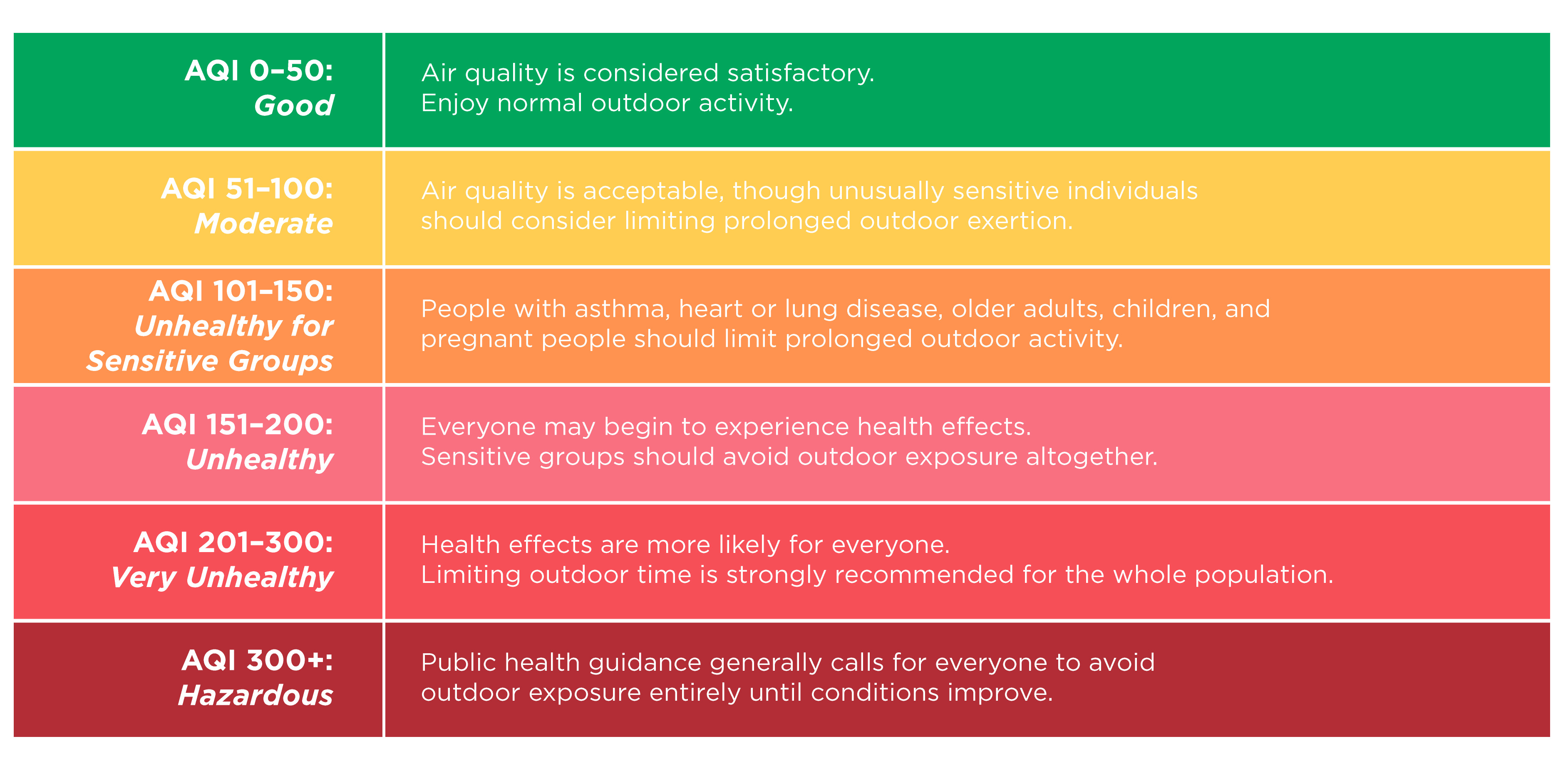
AQI 0–50: Good
Air quality is considered satisfactory. Enjoy normal outdoor activity.
AQI 51–100: Moderate
Air quality is acceptable, though unusually sensitive individuals should consider limiting prolonged outdoor exertion.
AQI 101–150: Unhealthy for Sensitive Groups
People with asthma, heart or lung disease, older adults, children, and pregnant people should limit prolonged outdoor activity.
AQI 151–200: Unhealthy
Everyone may begin to experience health effects. Sensitive groups should avoid outdoor exposure altogether.
AQI 201–300: Very Unhealthy
Health effects are more likely for everyone. Limiting outdoor time is strongly recommended for the whole population.
AQI 300+: Hazardous
Public health guidance generally calls for everyone to avoid outdoor exposure entirely until conditions improve.
Seek immediate care, call 911 or go to the nearest emergency room, if you experience:
If you're feeling "off" or unsure whether your symptoms are smoke-related, it's a good idea to check in with a medical professional. A quick evaluation can rule out anything serious and offer real peace of mind.
Schedule your ZoomCare visit today!

Dr. Kelli Westcott is ZoomCare's System Services Medical Director, specializing in Emergency Care, Family Medicine, Behavioral Health and PVMQ/SCT.
